Friday, August 13, 2010

Focus Fusion Update


depend on secondary devices working in the protocol environment.  See my many postings on the topic focus fusion.

Let us be serious.  We are witnessing a real creditable effort to produce fusion power that is arguably plausible.


AUGUST 09, 2010

Lawrenceville Plasma Physics (LPP) is trying to achieve commercial nuclear fusion.

LPP is trying to get up to 100,000 joules in each pulse. 60 such pulses would be 6 million joules per second, which if converted at with only about 20% loss would be equal to a 5 megawatt generator. The generator would cost about $200,000 and enable power to be generated 50 times cheaper than today.
1.      The first good news is that, with the Lexan insulators and tungsten pins, the spark plugs have lasted through over 200 shots without breaking


2. the amount of current we are producing per firing capacitor has improved. We have achieved 1 MA at 27 kV with only 8 capacitors firing, something that required all 12 capacitors with the old spark plugs. We believe that the large size of the tungsten pins and the better distribution of current has reduced the inductance of the switches and led to the increase in current, which makes us more confident that we can reach the design current for FF-1 of 2.8 MA.


3. Despite careful adjustment of the spark gaps, the simultaneity of firing with the new spark plugs is worse than with the old ones, and on average, only five switches are firing on the trigger. We believe we know the cause and cure of this problem. We have ordered this new power supply, which will increase the charging voltage on the trigger from 20 to 40 kV and will arrive near the end of August. We think that by doubling the rate of rise of the trigger pulse, we will be able to get the trigger voltage up to at least 20 kV before it shorts. That, together with the capacitor voltage of 30 kV, should get us to the 50 kV needed to fire all of the switches together. Another Dense Plasma Fusion project in Las Vegas is working reliably with higher voltages. The best switches cost a lot and are complicated to maintain. On the other hand, spark gap switches (our kind) with much higher trigger voltages—120 kV vs our current 20 kV—have been made to function reliably recently
From these numbers, we can calculate the product n^2V (where n is density and V is volume) for both the electrons and the ions. Both numbers are the same, 1.1+-0.1x10^35/cm^3. This is a strong indication that the X-rays and neutrons come from the same plasma, the plasmoid. It is also a good indication of how our instruments are designed to supplement and confirm each other, so that every measurement we take will be checked by at least two instruments


Biochar for Carbon Sequestration Study


This work is on a recent study done to evaluate the effect that adoption of biochar throughout the globe may have in terms of carbon sequestration.

The take home is that present regimes could comfortably handle up to fifteen percent of the CO2 produced and vented presently.

However, the real certainty is that we will be exiting the fossil fuel business over the coming century.  We are witnessing the first moves there in the massive emergence of successful wind energy production.  The real break will be fusion energy when we master that art.  In the meantime, Geothermal and solar will also emerge now at a great clip.
When we exit the fossil business also reforest the maximum open land which will massively increase the globe’s biomass, we are likely to swiftly create a CO2 deficit and will need to burn fossil fuels to make up the difference.

1.8 billion metric tons of carbon applied to land at say ten tons per acre will produce 200 million acres of fully involved terra preta soils.  This works out to be around a quarter million square miles per year.  Of course, in time we can just keep on adding carbon to fully involved soils but that then will not likely be necessary.

Also, as I have already posted, logistics and handling issues will likely make corn husbandry as the go to crop for this.  Most other crops simply produce too little usable waste.

And in spite of the ongoing chatter about using waste wood, it is not the first choice in terms of soils.  Most likely there the biochar will be screened for a fines fraction while the balance is used as a fuel for which it is well suited.

Offsetting greenhouse gas emissions using charcoal
00:11 August 11, 2010

According to a new study, as much as 12 percent of the world’s human-caused greenhouse gas emissions could be sustainably offset by producing biochar, a charcoal-like substance made from plants and other organic materials. That’s more than would be offset if the same plants and materials were burned to generate bioenergy, says the study. Additionally, biochar could improve food production in the world’s poorest regions as it increases soil fertility.

Biochar is made by decomposing biomass like plants, wood and other organic materials at high temperature in a process called slow pyrolysis – a form of incineration that decomposes organic materials by heat in the absence of oxygen. Normally, biomass breaks down and releases its carbon into the atmosphere within a decade or two. But biochar is more stable and can hold onto its carbon for hundreds or even thousands of years, keeping greenhouse gases like carbon dioxide out of the air longer.

Other biochar benefits include: improving soils by increasing their ability to retain water and nutrients; decreasing nitrous oxide and methane emissions from the soil into which it is tilled; and, during the slow pyrolysis process, producing some bio-based gas and oil that can offset emissions from fossil fuels.

The carbon-packed substance was first suggested as a way to counteract climate change in 1993. Scientists and policymakers have given it increasing attention in the past few years and this new study conducted by a collaborative team from the Department of Energy’s Pacific Northwest National Laboratory (PNNL), Swansea UniversityCornell University, and the University of New South Wales, is the most thorough and comprehensive analysis to date on the global potential of biochar.

The study
For their study, the researchers looked to the world’s sources of biomass that aren’t already being used by humans as food. For example, they considered the world’s supply of corn leaves and stalks, rice husks, livestock manure and yard trimmings, to name a few. The researchers then calculated the carbon content of that biomass and how much of each source could realistically be used for biochar production.

With this information, they developed a mathematical model that could account for three possible scenarios. In one, the maximum possible amount of biochar was made by using all sustainably available biomass. Another scenario involved a minimal amount of biomass being converted into biochar, while the third offered a middle course. The maximum scenario required significant changes to the way the entire planet manages biomass, while the minimal scenario limited biochar production to using biomass residues and wastes that are readily available with few changes to current practices.

The researchers found that the maximum scenario could offset up to the equivalent of 1.8 petagrams – or 1.8 billion metric tons – of carbon emissions annually and a total of 130 billion metric tons throughout in the first 100 years. Avoided emissions include the greenhouse gases carbon dioxide, methane and nitrous oxide. The estimated annual maximum offset is 12 percent of the 15.4 billion metric tons of greenhouse gas emissions that human activity adds to the atmosphere each year. Researchers also calculated that the minimal scenario could sequester just under 1 billion metric tons annually and 65 billion metric tons during the same period.

Making biochar sustainably requires heating mostly residual biomass with modern technologies that recover energy created during biochar’s production and eliminate the emissions of methane and nitrous oxide, the study also noted.

Biochar and bioenergy

Instead of making biochar, biomass can also be burned to produce bioenergy from heat. Researchers found that burning the same amount of biomass used in their maximum biochar scenario would offset 107 billion metric tons of carbon emissions during the first century. The bioenergy offset, while substantial, was 23 metric tons less than the offset from biochar.

Researchers attributed this difference to a positive feedback from the addition of biochar to soils. By improving soil conditions, biochar increases plant growth and therefore creates more biomass for biochar productions. Adding biochar to soils can also decrease nitrous oxide and methane emissions that are naturally released from soil.


However, the researchers say a flexible approach including the production of biochar in some areas and bioenergy in others would create optimal greenhouse gas offsets. Their study showed that biochar would be most beneficial if it were tilled into the planet’s poorest soils, such as those in the tropics and the Southeastern United States.

Those soils, which have lost their ability to hold onto nutrients during thousands of years of weathering, would become more fertile with the extra water and nutrients the biochar would help retain. Richer soils would increase the crop and biomass growth – and future biochar sources – in those areas. Adding biochar to the most infertile cropland would offset greenhouse gases by 60 percent more than if bioenergy were made using the same amount of biomass from that location, the researchers found.

On the other hand, the authors wrote that bioenergy production could be better suited for areas that already have rich soils - such as the Midwest – and that also rely on coal for energy. Their analysis showed that bioenergy production on fertile soils would offset the greenhouse gas emissions of coal-fired power plants by 16 to 22 percent more than biochar in the same situation.


Sustainability

The study also shows how sustainable practices can make the biochar that creates these offsets.

“The scientific community has been split on biochar,” says PNNL’s Jim Amonette. “Some think it’ll ruin biodiversity and require large biomass plantations. But our research shows that won’t be the case if the right approach is taken.”

The researchers’ estimates of avoided emissions were developed by assuming no agricultural or previously unmanaged lands will be converted for biomass crop production. Other sustainability criteria included leaving enough biomass residue on the soil to prevent erosion, not using crop residues currently eaten by livestock, not adding biochar made from treated building materials to agricultural soils and requiring that only modern pyrolysis technologies – those that fully recover energy released during the process and eliminate soot, methane and nitrous oxide emissions – be used for biochar production.

“Roughly half of biochar’s climate-mitigation potential is due to its carbon storage abilities,” Amonette said. “The rest depends on the efficient recovery of the energy created during pyrolysis and the positive feedback achieved when biochar is added to soil. All of these are needed for biochar to reach its full sustainable potential.”

The study, "Sustainable biochar to mitigate global climate change," appears in the journal Nature Communications.

Updating the Global Middle Class


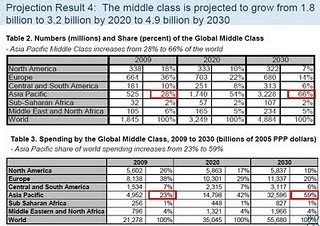
This item is a fresh reminder of the shear power of the S curve.  Largely everyone on the Globe today is actually on the curve at some point or another. A huge mass of Chinesse are entering the full acceleration phase and will create a huge internal demand.  The same is also true for India and possibly now Brazil.


There is one practical effect.  The supply excess US currency denominated credit out there will be sponged up far faster than anticipated and the damage caused by the first global financial crisis will be quickly repaired outside the USA.


It is noteworthy that foreign investors are now focused on resources because of this.  The world needs a number of huge copper mines to be commissioned.  Little of that will also flow into the US because the states are mostly viewed unfriendly to mining at all.  To start with, most lands are still managed under the original 1877 mining law and is a huge problem.  The rest of the world has mostly learned to welcome major mining companies, not least because artisan miners pay no taxes and massively damage the environment.

An inevitable billion man middle class will need a ten fold increase in raw material availability.


AUGUST 11, 2010


The Emerging Middle Class in Developing Countries by Homi Kharas of the Brookings Institute Middle class definition used is those spending $10-100 per day. Some interesting things to notice is that the projection is for the world economy to get to 200 trillion in 2005 dollars by 2036 up from about 70 trillion now. Asia will be over half of the world economy. North America will go from about 26% now to about 12%, which will be the same as central and south America. By 2024-2030, the dominant share of the middle class economy from India and China and the rest of Asia will established according the Kharas forecast. It would then be a shift from the lower end of the middle class range to the upper part.


Why WW II Ended in a Mushroom Cloud


The story presented for the closing days of the Second World War was always a little too pat.  This plausibly puts a different perspective on the situation and the concerns determining policy in the last days of the war.

It certainly served US interests to demonstrate the actual power of the atomic bomb.  I can not believe that anyone had a proper appreciation of the actual future role of the bomb itself but they certainly needed to convince the soviets not to exploit their strategic advantage.  Recall that communist doctrine called for a global communist polity that certainly included all of Europe.  The swift repositioning of surrendering German armies alongside western forces and Patten’s comments at the time shows us just how dicey it all was.

The atomic bomb made further Soviet gains impossible and put Stalin emotionally on the defensive.  As this article makes clear, Japan’s last hope evaporated with the Soviet declaration of war.  Their swift surrender was inevitable long before any American forces hit the beach and the US did have the option of landing in Korea instead and linking up with the Soviets while Japan starved and their Army was destroyed in China.

The A bomb was a game changer and the Soviet Union failed to win the Atomic peace.  This was not an obvious conclusion to make in 1945 when prior to the Second War the soviet economy had outstripped everyone else’s.


Why World War II ended with Mushroom Clouds

65 years ago, August 6 and 9, 1945: Hiroshima and Nagasaki

By Jacques R. Pauwels


On Monday, August 6, 1945, at 8:15 AM, the nuclear bomb ‘Little Boy” was dropped on Hiroshima by an American B-29 bomber, the Enola Gay, directly killing an estimated 80,000 people. By the end of the year, injury and radiation brought total casualties to 90,000-140,000.”[1]

“On August 9, 1945, Nagasaki was the target of the world's second atomic bomb attack at 11:02 a.m., when the north of the city was destroyed and an estimated 40,000 people were killed by the bomb nicknamed ‘Fat Man.’ The death toll from the atomic bombing totalled 73,884, as well as another 74,909 injured, and another several hundred thousand diseased and dying due to fallout and other illness caused by radiation.”[2]

In the European Theatre, World War II ended in early May 1945 with the capitulation of Nazi Germany. The “Big Three” on the side of the victors – Great Britain, the United States, and the Soviet Union – now faced the complex problem of the postwar reorganization of Europe. The United States had entered the war rather late, in December 1941, and had only started to make a truly significant military contribution to the Allied victory over Germany with the landings in Normandy in June 1944, less than one year before the end of the hostilities. When the war against Germany ended, however, Washington sat firmly and confidently at the table of the victors, determined to achieve what might be called its “war aims.”

As the country that had made the biggest contribution and suffered by far the greatest losses in the conflict against the common Nazi enemy, the Soviet Union wanted major reparation payments from Germany and security against potential future aggression, in the form of the installation in Germany, Poland and other Eastern European countries of governments that would not be hostile to the Soviets, as had been the case before the war. Moscow also expected compensation for territorial losses suffered by the Soviet Union at the time of the Revolution and the Civil War, and finally, the Soviets expected that, with the terrible ordeal of the war behind them, they would be able to resume work on the project of constructing a socialist society. The American and British leaders knew these Soviet aims and had explicitly or implicitly recognized their legitimacy, for example at the conferences of the Big Three in Tehran and Yalta. That did not mean that Washington and London were enthusiastic about the fact that the Soviet Union was to reap these rewards for its war efforts; and there undoubtedly lurked a potential conflict with Washington’s own major objective, namely, the creation of an “open door” for US exports and investments in Western Europe, in defeated Germany, and also in Central and Eastern Europe, liberated by the Soviet Union. In any event, American political and industrial leaders - including Harry Truman, who succeeded Franklin D. Roosevelt as President in the spring of 1945 - had little understanding, and even less sympathy, for even the most basic expectations of the Soviets. These leaders abhorred the thought that the Soviet Union might receive considerable reparations from Germany, because such a bloodletting would eliminate Germany as a potentially extremely profitable market for US exports and investments. Instead, reparations would enable the Soviets to resume work, possibly successfully, on the project of a communist society, a “counter system” to the international capitalist system of which the USA had become the great champion. America’s political and economic elite was undoubtedly also keenly aware that German reparations to the Soviets implied that the German branch plants of US corporations such as Ford and GM, which had produced all sorts of weapons for the Nazis during the war (and made a lot of money in the process[3]) would have to produce for the benefit of the Soviets instead of continuing to enrich US owners and shareholders.  

Negotiations among the Big Three would obviously never result in the withdrawal of the Red Army from Germany and Eastern Europe before the Soviet objectives of reparations and security would be at least partly achieved. However, on April 25, 1945, Truman learned that the US would soon dispose of a powerful new weapon, the atom bomb. Possession of this weapon opened up all sorts of previously unthinkable but extremely favorable perspectives, and it is hardly surprising that the new president and his advisors fell under the spell of what the renowned American historian William Appleman Williams has called a “vision of omnipotence.”[4] It certainly no longer appeared necessary to engage in difficult negotiations with the Soviets: thanks to the atom bomb, it would be possible to force Stalin, in spite of earlier agreements, to withdraw the Red Army from Germany and to deny him a say in the postwar affairs of that country, to install “pro-western” and even anti-Soviet regimes in Poland and elsewhere in Eastern Europe, and perhaps even to open up the Soviet Union itself to American investment capital as well as American political and economic influence, thus returning this communist heretic to the bosom of the universal capitalist church.

At the time of the German surrender in May 1945, the bomb was almost, but not quite, ready. Truman therefore stalled as long as possible before finally agreeing to attend a conference of the Big Three in Potsdam in the summer of 1945, where the fate of postwar Europe would be decided. The president had been informed that the bomb would likely be ready by then - ready, that is, to be used as “a hammer,” as he himself stated on one occasion, that he would wave “over the heads of those boys in the Kremlin.”[5]  At the Potsdam Conference, which lasted from July 17 toAugust 2, 1945, Truman did indeed receive the long-awaited message that the atom bomb had been tested successfully on July 16 in New Mexico. As of then, he no longer bothered to present proposals to Stalin, but instead made all sorts of demands; at the same time he rejected out of hand all proposals made by the Soviets, for example concerning German reparation payments, including reasonable proposals based on earlier inter-Allied agreements. Stalin failed to display the hoped-for willingness to capitulate, however, not even when Truman attempted to intimidate him by whispering ominously into his ear that America had acquired an incredible new weapon. The Soviet sphinx, who had certainly already been informed about the American atom bomb, listened in stony silence. Somewhat puzzled, Truman concluded that only an actual demonstration of the atomic bomb would persuade the Soviets to give way. Consequently, no general agreement could be achieved at Potsdam. In fact, little or nothing of substance was decided there. “The main result of the conference,” writes historian Gar Alperovitz, “was a series of decisions to disagree until the next meeting.”[6]

In the meantime the Japanese battled on in the Far East, even though their situation was totally hopeless. They were in fact prepared to surrender, but they insisted on a condition, namely, that Emperor Hirohito would be guaranteed immunity. This contravened the American demand for an unconditional capitulation. In spite of this it should have been possible to end the war on the basis of the Japanese proposal. In fact, the German surrender at Reims three months earlier had not been entirely unconditional.

 (The Americans had agreed to a German condition, namely, that the armistice would only go into effect after a delay of 45 hours, a delay that would allow as many German army units as possible to slip away from the eastern front in order to surrender to the Americans or the British; many of these units would actually be kept ready - in uniform, armed, and under the command of their own officers – for possible use against the Red Army, as Churchill was to admit after the war.)[7] 

In any event,Tokyo’s sole condition was far from essential. Indeed, later - after an unconditional surrender had been wrested from the Japanese - the Americans would never bother Hirohito, and it was thanks to Washington that he was to be able to remain emperor for many more decades.[8]

The Japanese believed that they could still afford the luxury of attaching a condition to their offer to surrender because the main force of their land army remained intact, in China, where it had spent most of the war. Tokyo thought that it could use this army to defend Japan itself and thus make the Americans pay a high price for their admittedly inevitable final victory, but this scheme would only work if the Soviet Union stayed out of the war in the Far East; a Soviet entry into the war, on the other hand, would inevitably pin down the Japanese forces on the Chinese mainland. Soviet neutrality, in other words, permitted Tokyo a small measure of hope; not hope for a victory, of course, but hope for American acceptance of their condition concerning the emperor. To a certain extent the war with Japan dragged on, then, because the Soviet Union was not yet involved in it. Already at the Conference of the Big Three in Tehran in 1943, Stalin had promised to declare war on Japan within three months after the capitulation of Germany, and he had reiterated this commitment as recently as July 17, 1945, in Potsdam.

 Consequently, Washington counted on a Soviet attack on Japan by the middle of August and thus knew only too well that the situation of the Japanese was hopeless. (“Fini Japs when that comes about,” Truman confided to his diary, referring to the expected Soviet entry into the war in the Far East.)[9] In addition, the American navy assured Washington that it was able to prevent the Japanese from transferring their army from China in order to defend the homeland against an American invasion. Since the US navy was undoubtedly able to force Japan to its knees by means of a blockade, an invasion was not even necessary. Deprived of imported necessities such as food and fuel, Japan could be expected to beg to capitulate unconditionally sooner or later.    

In order to finish the war against Japan, Truman thus had a number of very attractive options. He could accept the trivial Japanese condition with regard to immunity for their emperor; he could also wait until the Red Army attacked the Japanese in China, thus forcing Tokyo into accepting an unconditional surrender after all; or he could starve Japan to death by means of a naval blockade that would have forced Tokyo to sue for peace sooner or later. Truman and his advisors, however, chose none of these options; instead, they decided to knock Japan out with the atomic bomb. This fateful decision, which was to cost the lives of hundreds of thousands of people, mostly women and children, offered the Americans considerable advantages. First, the bomb might force Tokyo to surrender before the Soviets got involved in the war in Asia, thus making it unnecessary to allow Moscow a say in the coming decisions about postwar Japan, about the territories which had been occupied by Japan (such as Korea and Manchuria), and about the Far East and the Pacific region in general. The USA would then enjoy a total hegemony over that part of the world, something which may be said to have been the true (though unspoken) war aim of Washington in the conflict with Japan. It was in light of this consideration that the strategy of simply blockading Japan into surrender was rejected, since the surrender might not have been forthcoming until after – and possibly well after - the Soviet Union’s entry into the war. (After the war, the U.S. Strategic Bombing Survey stated that “certainly prior to 31 December 1945, Japan would have surrendered, even if the atomic bombs had not been dropped.”)[10]

As far as the American leaders were concerned, a Soviet intervention in the war in the Far East threatened to achieve for the Soviets the same advantage which the Yankees’ relatively late intervention in the war in Europe had produced for the United States, namely, a place at the round table of the victors who would force their will on the defeated enemy, carve occupation zones out of his territory, change borders, determine postwar social-economic and political structures, and thereby derive for themselves enormous benefits and prestige. Washington absolutely did not want the Soviet Union to enjoy this kind of input. The Americans were on the brink of victory over Japan, their great rival in that part of the world. They did not relish the idea of being saddled with a new potential rival, one whose detested communist ideology might become dangerously influential in many Asian countries. By dropping the atomic bomb, the Americans hoped to finish Japan off instantly and go to work in the Far Eastas cavalier seul, that is, without their victory party being spoiled by unwanted Soviet gate-crashers. Use of the atom bomb offered Washington a second important advantage. Truman’s experience in Potsdam had persuaded him that only an actual demonstration of this new weapon would make Stalin sufficiently pliable. Nuking a “Jap” city, preferably a “virgin” city, where the damage would be especially impressive, thus loomed useful as a means to intimidate the Soviets and induce them to make concessions with respect to GermanyPoland, and the rest of Central andEastern Europe.

The atomic bomb was ready just before the Soviets became involved in the Far East. Even so, the nuclear pulverization of Hiroshima on August 6, 1945, came too late to prevent the Soviets from entering the war against Japan. Tokyo did not throw in the towel immediately, as the Americans had hoped, and on August 8, 1945 - exactly three months after the German capitulation in Berlin - the Soviets declared war on Japan. The next day, on August 9, the Red Army attacked the Japanese troops stationed in northern China. Washington itself had long asked for Soviet intervention, but when that intervention finally came, Truman and his advisors were far from ecstatic about the fact that Stalin had kept his word. IfJapan’s rulers did not respond immediately to the bombing of Hiroshima with an unconditional capitulation, it may have been because they could not ascertain immediately that only one plane and one bomb had done so much damage. (Many conventional bombing raids had produced equally catastrophic results; an attack by thousands of bombers on the Japanese capital on March 9-10, 1945, for example, had actually caused more casualties than the bombing of Hiroshima.) In any event, it took some time before an unconditional capitulation was forthcoming, and on account of this delay the USSR did get involved in the war against Japan after all. This made Washington extremely impatient: the day after the Soviet declaration of war, on August 9, 1945, a second bomb was dropped, this time on the city of Nagasaki. A former American army chaplain later stated: “I am of the opinion that this was one of the reasons why a second bomb was dropped: because there was a rush. They wanted to get the Japanese to capitulate before the Russians showed up.”[11] (The chaplain may or may not have been aware that among the 75,000 human beings who were “instantaneously incinerated, carbonized and evaporated” in Nagasaki were many Japanese Catholics as well an unknown number of inmates of a camp for allied POWs, whose presence had been reported to the air command, to no avail.)[12] It took another five days, that is, until August 14, before the Japanese could bring themselves to capitulate. In the meantime the Red Army was able to make considerable progress, to the great chagrin of Truman and his advisors.

And so the Americans were stuck with a Soviet partner in the Far East after all. Or were they? Truman made sure that they were not, ignoring the precedents set earlier with respect to cooperation among the Big Three in Europe. Already on August 15, 1945, Washington rejected Stalin’s request for a Soviet occupation zone in the defeated land of the rising sun. And when on September 2, 1945, General MacArthur officially accepted the Japanese surrender on the American battleship Missouri in the Bay of Tokyo, representatives of the Soviet Union - and of other allies in the Far East, such as Great Britain, France, Australia, and the Netherlands - were allowed to be present only as insignificant extras, as spectators. Unlike GermanyJapan was not carved up into occupation zones. America’s defeated rival was to be occupied by the Americans only, and as American “viceroy” in Tokyo, General MacArthur would ensure that, regardless of contributions made to the common victory, no other power had a say in the affairs of postwar Japan.

Sixty-five years ago, Truman did not have to use the atomic bomb in order to force Japan to its knees, but he had reasons to want to use the bomb. The atom bomb enabled the Americans to force Tokyo to surrender unconditionally, to keep the Soviets out of the Far East and - last but not least - to force Washington’s will on the Kremlin in Europe also. Hiroshima and Nagasaki were obliterated for these reasons, and many American historians realize this only too well; Sean Dennis Cashman, for example, writes:

With the passing of time, many historians have concluded that the bomb was used as much for political reasons...Vannevar Bush [the head of the American center for scientific research] stated that the bomb “was also delivered on time, so that there was no necessity for any concessions toRussia at the end of the war”. Secretary of State James F. Byrnes [Truman’s Secretary of State] never denied a statement attributed to him that the bomb had been used to demonstrate American power to the Soviet Union in order to make it more manageable in Europe.[13]

Truman himself, however, hypocritically declared at the time that the purpose of the two nuclear bombardments had been “to bring the boys home,” that is, to quickly finish the war without any further major loss of life on the American side. This explanation was uncritically broadcast in the American media and it developed into a myth eagerly propagated by the majority of historians and media in the USA and throughout the “Western” world. That myth, which, incidentally, also serves to justify potential future nuclear strikes on targets such as Iran and North Korea, is still very much alive - just check your mainstream newspaper on August 6 and 9!

Jacques R. Pauwels, author of The Myth of the Good War: America in the Second World War, James Lorimer, Toronto, 2002


Notes

[1] http://en.wikipedia.org/wiki/Hiroshima.
[2] http://en.wikipedia.org/wiki/Nagasaki.
[3] Jacques R. Pauwels, The Myth of the Good War: America in the Second World War, Toronto, 2002, pp. 201-05.
[4] William Appleman Williams, The Tragedy of American Diplomacy, revised edition, New York, 1962, p. 250.
[5] Quoted in Michael Parenti, The Anti-Communist Impulse, New York, 1969, p. 126.
[6] Gar Alperovitz Atomic Diplomacy: Hiroshima and Potsdam. The Use of the Atomic Bomb and the American Confrontation with Soviet Power, new edition, Harmondsworth, Middlesex, 1985 (original edition 1965), p. 223.
[7] Pauwels, op. cit., p. 143.
[8] Alperovitz, op. cit., pp. 28, 156.
[9] Quoted in Alperovitz, op. cit., p. 24.
[10] Cited in David Horowitz, From Yalta to Vietnam: American Foreign Policy in the Cold War, Harmondsworth, MiddlesexEngland, 1967, p. 53.
[11] Studs Terkel, "The Good War": An Oral History of World War Two, New York, 1984, p. 535.
[12] Gary G. Kohls, “Whitewashing Hiroshima: The Uncritical Glorification of American Militarism,” http://www.lewrockwell.com/orig5/kohls1.html.
[13] Sean Dennis Cashman, , Roosevelt, and World War II, New York and London, 1989, p. 369.

Thursday, August 12, 2010

Nevada's Renewable Energy


I was down in Las Vegas to attend a nephew’s wedding (which is why no posts for a couple of days) and got a chance to pick up this local story on renewable energy.

It has been obvious to me that the state is the natural base for geothermal production with solar and wind as a bonus as it applies.  Exporting this power first to California and then East is obvious.

The State needs to make it as important as gambling and mining in terms of political support.  It is able to produce thousands of local jobs and will anchor Nevada’s economy for as long as these sources are competitive which is likely forever.  Even fusion energy will want to get properly paid out however cheap it turns out to be.

In fact renewables do one thing well.  They pay off their loans.  Then they simply make money at a low cost base forever.  No one can compete with a paid for windmill or a paid for geothermal plant or even paid for solar installations.  Dams are exactly the same.  The Aswan was paid off decades ago as was the Hoover Dam.

Nevada needs to create an energy transmission trust to accelerate industry growth whose mandate is to hook up new supplies and get it first to California.  We are perhaps three to five years from an economic super conducting link into California.  Anything permitted today will feed that connection.

To indicate just how important that will be consider that building a super conducting link from James Bay  to New York will possibly double energy supply to New York. (I would love to have real numbers here by the way if you can help)

The initial build out will strengthen the local power base and it is a good bet the Hoover Dam will quickly switch to superconducting lines providing the needed trunk.  The State needs to be part of all that.

In the meantime this item tells me they are all asleep as yet.

RENEWABLE ENERGY: Nevada shows powerful potential 

But no one knows where political winds will blow 


NEVADANS SPLIT ON ENERGY


If Nevada’s voters don’t have strong opinions on renewable energy, they also don’t break one way or the other on whether offshore drilling should continue in the Gulf of Mexico following the BP oil spill.


Just under half — 48 percent — of voters in a new Review-Journal survey said they oppose a ban on offshore oil drilling in the gulf. Another 37 percent said they support a drilling moratorium, while 15 percent remained undecided.


Mason-Dixon Polling & Research of Washington, D.C., conducted the survey from Monday through Wednesday. A total of 625 registered voters were interviewed statewide by telephone. The margin of error is 4 percentage points.


LAS VEGAS REVIEW-JOURNAL


Sure, Nevada's practically all desert, but in one area, the Silver State claims some of the greenest pastures on Earth.
For green-energy potential, few places beat Nevada.

 But just how much potential the state offers will depend on a multitude of issues, including technological hurdles, financial obstacles and even political will. Some experts say renewables could completely displace fossil fuels such as coal and natural gas in Nevada's energy economy, while others assert the green-power movement is destined to peter out as the costs and inconveniences of such generation unfold.

Here's what is not up for debate: Nevada owns one of the country's biggest renewable bases. Unlike most states, Nevada offers major access to sunlight, hot springs and wind -- three key sources of green power.

Data from the federal Energy Information Administration show that nearly half of Nevada has enough sunlight to generate at least 6 kilowatt hours of solar power per square meter daily. Another sizeable chunk receives enough sun to yield 4 to 6 kilowatt hours per square meter every day.

Roughly half the state houses enough underground hot springs to produce at least 80 milliwatts of geothermal power per square meter, and about 25 percent of Nevada has enough wind to host utility-scale wind farms.

So rich is Nevada's renewable-power base that John White, executive director of the Center for Energy Efficiency and Renewable Technologies in Sacramento, Calif., said it's conceivable the state eventually could derive all of its power from alternative sources, and send leftovers to surrounding states.

"Nevada is abundantly blessed with renewable-energy resources," White said. "There's no question Nevada has the potential to be completely reliant on renewable energy for its power needs, and to be a net exporter."

Nevada law requires power utility NV Energy to get 25 percent of its electricity from renewable sources by 2025, up from 12 percent in 2010.

So, the state is already positioned for considerable growth beyond NV Energy's existing renewable portfolio of 1,200 megawatts, or 44 projects completed, planned or under construction. And that's not to mention the dozens of renewable projects in the state that are planned but contracted to sell power to the utility. The utility's 2009 conference for groups interested in offering renewable power to the company drew 240 attendees, so there's no shortage of interest in the state's green-power prospects.
But Nevada also has the goods to go national, becoming a distributor of renewable energy to other states, said David Hicks, NV Energy's director of renewable-energy procurement and technical services. Witness Sempra Generation's 58-megawatt Copper Mountain solar plant in Boulder City, which will serve California customers of Pacific Gas & Electric.

"It's clear the renewable potential in Nevada far exceeds the demand for it under the portfolio standard," Hicks said. "There is significant potential to export renewable generation outside the state."

Still, resources alone can't guarantee renewable development.

"It's certainly conceivable that we could fuel our entire (car) fleet from cellulosic sources and get all of our electricity from renewable energy, but the cost would be staggering, in consumer prices, in government support and in other conveniences, such as more variable supplies of power," said Jerry Taylor, a senior fellow with the Cato Institute, a libertarian think tank in Washington, D.C.

For an idea of how tough it will be to replace existing capacity, Taylor said, consider the difficulty states have experienced meeting renewable-power mandates. Nevada's standard, which the Legislature passed in 2001, went unmet until NV Energy achieved the requirement for the first time in 2008. The utility missed the mark again in 2009. Company executives have blamed timing issues on the shortfall. And three big utilities in California will fall about two percentage points short of their 20 percent mandate by year's end.

But many of those portfolio deficits come from temporary travails, experts said. Get past those troubles, renewable advocates say, and green energy could really take off.

Consider financing. Before the real estate bust of two years ago, finding funding for construction of renewable plants was easier, Hicks said. Today, renewable developers have the same problems obtaining loans as any other sector is seeing, and that has made projects harder to finance. As the economy recovers, loans should pick up again, Hicks said.

And then there are transmission lines. Or rather, there aren't transmission lines. Many renewables originate in remote areas far from existing grids, so the power the projects generate is stranded, unable to make its way into power companies' portfolios. Taylor said that's the case in Texas, for example, where some wind turbines yield power that goes nowhere, simply because the farms don't link to transmission networks.

Planned transmission solutions here include NV Energy's One Nevada line (ONLine), a 235-mile connection that will link the utility to renewable generation in rural Nevada. ONLine is scheduled for completion by early 2013.

White said it would be relatively easy to beef up existing transmission corridors connecting Nevada to California, Arizona and other Western states so that regional players could develop and share resources ranging from hydroelectricity to wind to biomass.

Technological barriers also could curb renewables' potential in Nevada. Solar arrays need water -- the Solar Energy Industries Association estimates an average of 20 gallons per megawatt hour -- for everything from cooling exhaust steam to cleaning photovoltaic panels.

The demand for water could be a big impediment in parched, arid Nevada, though developers more recently have proposed solar plants that cool exhaust steam with air rather than water. As for washing panels, plants can use brackish or reclaimed water, White said.

Other technological obstacles could prove more enduring. The sun will always set, and the wind will always stop. That means a constant need for fossil fuel-generated backup power, Taylor noted, and the power-grid whiplash resulting from a sudden cloudburst over a solar plant could cause brownouts or blackouts as the quick change in power sources shocks the system.

The intermittent nature of renewables is especially an issue with wind farms. Wind typically blows most intensely during midwinter nights, rendering it useless during peak-power periods on hot summer days, Taylor said.

Also likely to stick around are permitting issues. Renewable plants must obtain federal or state approval in a licensing process that can take years. Complying with the National Environmental Policy Act can create uncertainties for projects, as the environmental impact review could either turn up few problems or uncover development killers such as the presence of an en dangered species, Hicks said.

Uncertainties also surround federal subsidies that make today's renewable power economically viable. Many tax credits, grants and loan guarantees are set to expire in the next three years or so, which would leave renewable projects without the funding that makes them economically competitive with conventional energy sources. But White said improving technologies will reduce the costs of renewable power, and that should enable green projects to get built with less funding in the long run.

The great unknown is whether the political will exists to stick with energy forms that can cost two to four times as much as conventional sources. A Mason-Dixon poll conducted for the Review-Journal doesn't show major voter sentiment in either direction, with 47 percent of Nevada voters saying they would like to keep Nevada's renewable portfolio standard and 39 percent saying the Legislature should repeal the mandate. Another 14 percent were undecided. The margin of error is 4 percentage points.

"As long as voters reward politicians for keeping these programs in place, then renewable-energy preferences, such as subsidies and mandates, will continue regardless of how renewables perform," Taylor said.

Still, Taylor said federal research shows renewables have a long way to go before they replace fossil fuels in the nation's energy makeup, so they are unlikely to dominate any individual state's energy profile. If all existing subsidies continue in perpetuity, renewable energy would rise to just 12.4 percent of electricity production by 2035, the Energy Information Administration projected.

"There's a tremendous amount of overstatement regarding what will happen in the future given current policy trends," Taylor said. "You need truly Herculean changes in the law to see anything close to what politicians talk about. Consumers would have to pay higher prices and be more vulnerable to dislocations on the grid."

But don't confuse the nation's renewable outlook with Nevada's, White responded. Follow serious conservation efforts with a "sustained and orderly build-out" of renewable capacity, and Nevada could get all of its electricity from green power by 2050, he said.

"There are challenges to renewable energy, but there are no show-stoppers."

Contact reporter Jennifer Robison at jrobison@reviewjournal.com or 702-380-4512.